The Indian National Biology Olympiad (INBO) is India’s most prestigious biology competition for pre-university students. Conducted by the Homi Bhabha Centre for Science Education (HBCSE–TIFR), it is part of the National Olympiad Programme designed to identify, train, and select India’s team for the International Biology Olympiad (IBO).
Unlike conventional school examinations, INBO focuses on conceptual understanding, scientific reasoning, and the application of biological principles rather than rote memorization. Success in INBO requires curiosity, analytical thinking, and a strong foundation in biology.
What does INBO test?
INBO assesses deep conceptual understanding, biological reasoning, and problem-solving ability across a broad range of topics. The exam tests more than factual recall — it emphasizes interpretation, data analysis, and application of core concepts to novel situations.
Eligibility
To appear for INBO, candidates generally must:
Be an Indian citizen and satisfy the age and academic eligibility criteria announced by HBCSE for the respective year. Eligibility criteria may change slightly each year. Always refer to the latest HBCSE notification before applying.
Exam pattern (Recent)
| Maximum marks | 300 |
| Duration | 2 Hours |
The question paper consists of two sections: Section A and Section B.
Section A contains 34 multiple-choice questions (MCQs), each with a single correct answer. Each question carries 1 mark, and negative marking is applied for incorrect answers as per the official marking scheme.
Section B consists of approximately 29 questions. The questions carry different marks depending on their complexity and may include multiple-correct questions, analytical problems, and data interpretation. The marks assigned to each question are clearly indicated in the question paper.
INBO Syllabus
The syllabus extends well beyond the NCERT curriculum and places greater emphasis on conceptual depth and analytical thinking. Major topics include:
- Cell Biology
- Genetics and Evolution
- Plant sciences
- Animal sciences
- Ecology and Ethology
- Biosystematics
- Biotechnology and Molecular techniques
Recommended study resources
A strong preparation strategy combines school textbooks with standard reference books and extensive practice.
Foundation
- NCERT Biology (Class XI & XII)
Reference books
- Campbell Biology
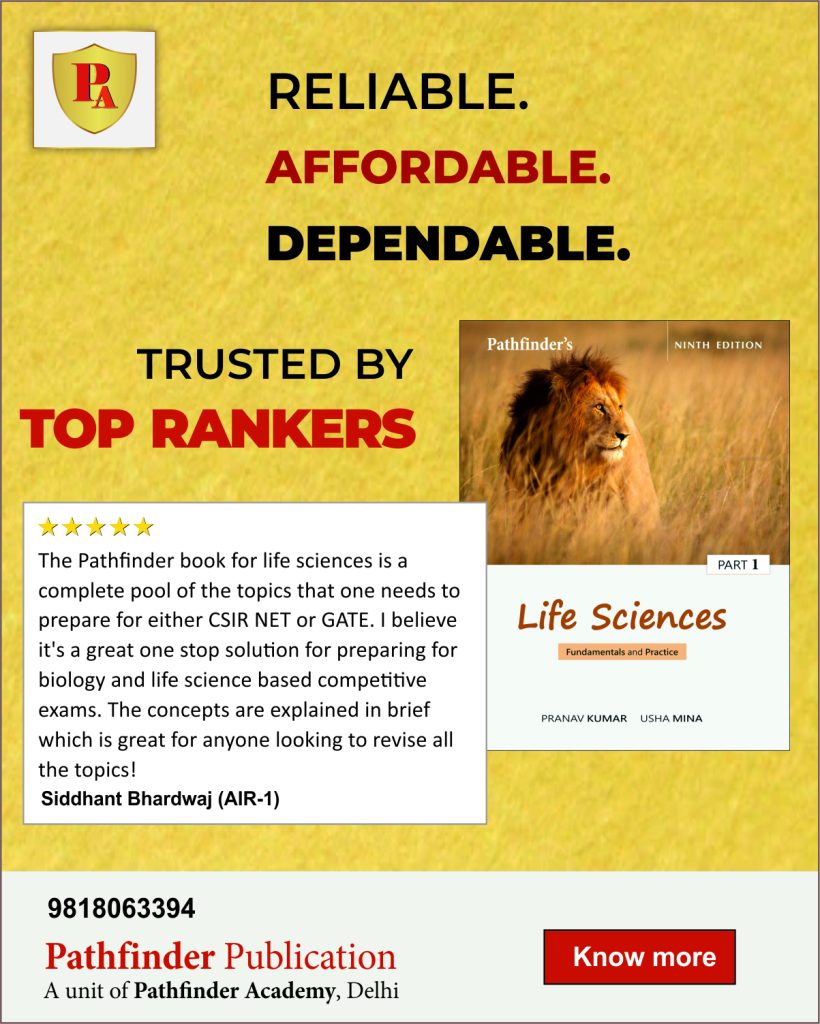
- Life Sciences – Fundamentals and Practice (Part 1 & Part 2) by Pranav Kumar and Usha Mina (Pathfinder Publication)
- Biophysical and Molecular Biology Techniques by Pranav Kumar (Pathfinder Publication)
Additional resources
- Previous INBO and IBO question papers
- Official HBCSE resource pages and sample papers
- Laboratory manuals and practical exercises
Why is INBO challenging?
INBO is considerably more demanding than school examinations and is generally more analytical than competitive exams such as NEET. The questions are designed to assess scientific thinking rather than factual recall.
Students are expected to:
- Integrate concepts from multiple areas of biology.
- Analyze unfamiliar experimental situations.
- Interpret scientific evidence.
- Apply biological principles to solve real-world problems.
Final thoughts
The Indian National Biology Olympiad is more than just a competitive examination—it is an opportunity for passionate biology students to explore the subject at an advanced level and represent India on the international stage. With a strong conceptual foundation, disciplined preparation, and regular practice, students can perform exceptionally well and progress toward the International Biology Olympiad (IBO). Whether you aspire to become a biologist, doctor, researcher, or biotechnologist, preparing for INBO will significantly strengthen your scientific reasoning and deepen your understanding of biology.